Four Things Killing Your Fiddle Leaf Fig Tree (Plus: How to Save it From Each Deadly Threat)
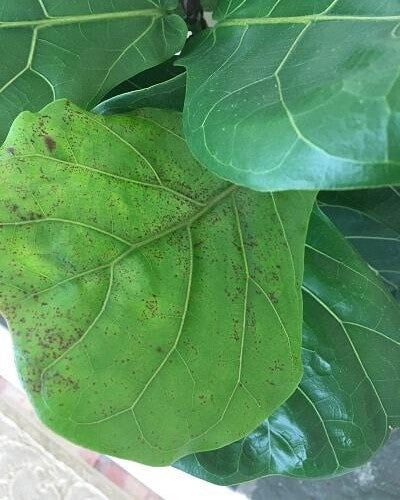

“Help! S.O.S! Mayday! 911! My fiddle leaf fig tree is dying, and I don’t know what to do!” By far, this is the most common distress signal we hear from readers and community members here at fiddleleaffigplant.com.
Inevitably, the answer falls into one of four categories: environment, a disease, pests, or the caregiver’s own treatment. Let’s take a look at each one.
The best houseplant strategist will read up on what a ficus lyrata needs before considering bringing one home. Instead, though, many of us impulsively grab one simply because they’re on the clearance rack at the local home improvement store. Who can resist?

Sadly, when the tree suffers, then its new owner is apt to hop online and—often too late—seek advice.
The most common threat to a fiddle leaf fig’s health is its environment.

When a ficus lyrata’s environment isn’t ideal, it’s more susceptible to disease. There are three bacterial and seven fungal infections known to plague the ficus family: crown gall, pseudomonas leaf spot, and xanthomonos leaf spot are each caused by a specific bacterium, while anthracnose, botrytis blight, corynespora leaf spot, myrothecium leaf spot, rhizoctonia root rot, phytophthora/pythium, and southern blight represent the fungal threats facing your plant.
Symptoms of disease include yellowing, shriveled, or droopy leaves, brown spots, leaf drop, stunted new growth, and, eventually, death. By far, the most common fiddle leaf fig disease is root rot, a condition which presents one, some of, or even all of these symptoms.

To treat root rot, first make sure your diagnosis is accurate. Then pull your plant out of its pot, identify and cut away wet, mushy, dark roots, and let your tree dry out a bit.

Then repot your plant’s root ball in fresh, quickly draining soil and a planter pot with plenty of drainage.
Using a moisture meter like this one helps you know when your plant is thirsty.
If your fiddle leaf fig still needs help or you would like to protect it in the future, we’ve spent over a year creating a treatment to protect your plant from root rot infections. Our root rot treatment is a natural plant bio-stimulator, enhancing your plant’s existing immune response and promoting growth.
It was designed with input from microbiologists, fiddle leaf fig growers, and botanists. It provides protection against the common Pythium, Pphytophthora, and pseudo-fungi that cause root rot in fiddle leaf figs. It’s gentle and safe for your plant, designed to be used every time you water, along with Fiddle Leaf Fig Plant Food. Get yours today on Amazon.
Another threat to your ficus lyrata is an unseen insect infestation. We say “unseen” because often by the time a fiddle leaf fig caregiver is aware of the problem, it’s already out of control.
Spider mites, mealybugs, and fungus gnats are the most common pests known to plague the ficus lyrata.
Each bug infestation manifests differently: spider mites are characterized by tiny rust-colored clusters of dots with the silky web.

Mealybugs appear with a cottony substance and wet honeydew. Fungus gnats can be entirely invisible or show themselves in a cloud of fruit fly-looking swarms when you or a family member walks by.
The good news is that treatment options for these pests are generally simple and effective. That is, if you’re willing to employ some consistent observation and diligence, chances are good you’ll be able to get rid of the buggers.

Use our Houseplant Leaf Armor, designed for houseplants to protect against insects, bacteria, and fungus. (This product works just like neem oil but without the unpleasant smell! As an added bonus, the Houseplant Leaf Armor also cleans and adds shine to your houseplant’s leaves.)
Unfortunately, a caregiver’s own loving attention often kills a fiddle leaf fig tree. That’s because when one of the three problems above manifests, humans (especially us plant-loving ones) tend to over-treat the problem. Here are a few of the most common examples:
By now, you should know exactly what’s harming your favorite houseplant. Diagnosis is the first step to correcting the problem and preventing a future recurrence. The next step is to learn exactly how to treat every issue and improve your fiddle leaf fig’s environment so it has what it needs to combat deprivation, disease, and insects naturally on its own. For that, grab a copy of The Fiddle Leaf Fig Expert. It’s your ultimate handbook for growing healthy, happy ficus lyrata plants. The book is available in full-color paperback or Kindle edition on Amazon now!


We are an Amazon Certified Small Business! Small businesses are the backbone of the US economy; they create jobs and drive innovation. We appreciate YOU helping small businesses on Amazon!