Your Top 5 African Violet Food FAQs Answered!
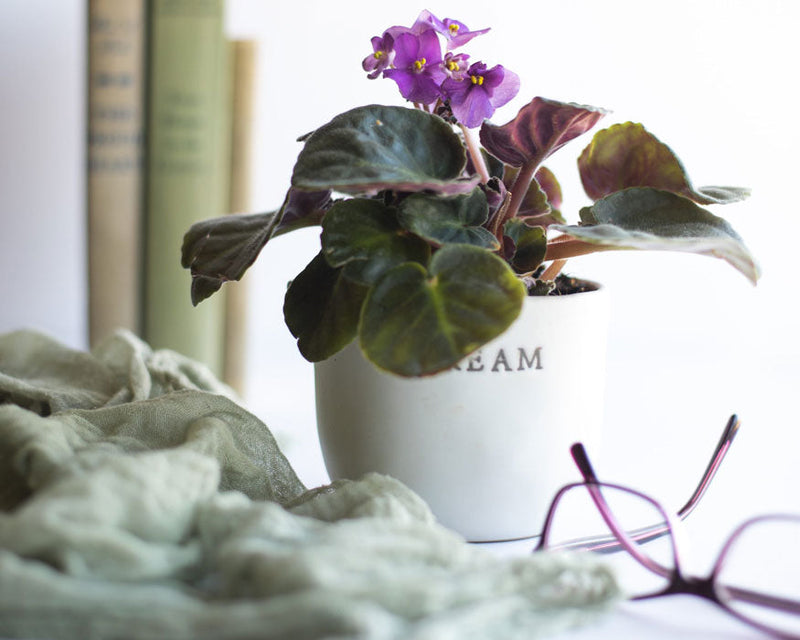


Like all plants, African violets power their essential processes by drawing nutrients from the soil around them. In the wild, natural cycles replenish these nutrients as they’re depleted. Unfortunately, in your living room, that’s not the case. Over time, a potted plant will use up all the nutrients from the soil in which it’s planted. And that’s bad news for hungry houseplants.
Enter African violet plant food!
Regularly fertilizing your plant replenishes the nutrients your plant needs to grow healthy and strong. Three essential nutrients (nitrogen, potassium, and phosphorus) and several secondary nutrients help power healthy foliage, vibrant blooms, and strong root systems. Simply put: your plant needs them to survive.
There are numerous ways to fertilize your African violet. From pellets to liquids to powders; fast-acting to slow-release; and a variety of nutrient compositions—it can get overwhelming! Don’t sweat it, just take a deep breath and look for the following:
Urea-Free Product
Many fertilizers, particularly budget options, derive nitrogen from an organic compound called urea. While cheap and effective, urea can be harmful to delicate plants like the African violet. We recommend choosing a urea-free African violet food to prevent root burn and other problematic side effects.
100% Water-Soluble
Your plant absorbs fertilizer by absorbing nutrient-infused water through its roots. That’s why you want to make sure your African violet food is 100% water-soluble. Otherwise, your plant won’t be able to synthesize the entire mix and will miss out on a well-rounded meal.
African Violet-Specific
We always recommend selecting a fertilizer that is specifically formulated for your plant. That’s because different species of plants evolved from different environments function best with different levels of certain nutrients. An African violet-specific plant food will ensure your fuzzy friend gets exactly what it needs for dinner.
Want to skip the guesswork? Our gentle, liquid blend is formulated with your plant in mind and safe to use every time you water!
Whatever method you select, don’t forget Rule #1 of African violet plant food: follow the directions! Every type of fertilizer and individual product will have specific usage requirements. The most important thing you can do is to take the time to read the instructions on the package before applying.
Uh oh! Been a little too generous with your plant food? Don’t worry, there’s a good chance your plant will recover. But first, here’s what to look for:
How to treat African violet overfertilization
An under-fertilized African violet is starved of the nutrients it needs to function, causing it to weaken and struggle to grow. Here are the signs your plant needs a good meal:
Here’s how to treat an under-fertilized African violet:
Whether you’re just starting out or are a seasoned grower, African Violet Resource Center has everything you need to help your plant grow vibrant and strong. Explore our other articles, visit our online shop, and connect with other houseplant lovers in our Facebook group to learn everything you need to know about this rewarding hobby!
5 Growing Tips to Consider Before You Buy an African Violet Plant
8 Tricks to Get Your African Violet to Bloom Again
6 Signs Your African Violet Is Dying and How to Revive It
Endless Summer: Here’s How to Grow an African Violet Garden That BLOOMS

We are an Amazon Certified Small Business! Small businesses are the backbone of the US economy; they create jobs and drive innovation. We appreciate YOU helping small businesses on Amazon!